

USA
2022 Olympic finish
Silver medal
2025 IIHF Women's World Championship finish
Gold medal
IIHF World Ranking
1st overall
The IIHF uses results from four years (2022-2025) to determine these rankings. New rankings will be released after the Olympics.
Forwards
Hannah Bilka, Alex Carpenter, Kendall Coyne-Schofield, Britta Curl-Salemme, Joy Dunne, Taylor Heise, Tessa Janecke, Hilary Knight, Abbey Murphy, Kelly Pannek, Hayley Scamurra, Kirsten Simms, Grace Zumwinkle
Defense
Cayla Barnes, Laila Edwards, Rory Guilday, Caroline Harvey, Megan Keller, Lee Stecklein, Haley Winn
Goaltenders
Aerin Frankel, Ava McNaughton, Gwyneth Philips
Head coach
John Wroblewski
Recent results against Olympic opponents (last two seasons):
v. Canada: W 4-1 (13 December 2025), W 10-4 (10 December 2025), W 6-1 (8 November 2025), W 4-1 (6 November 2025), W 4-3 (OT) (20 April 2025), W 2-1 (13 April 2025), L 3-1 (8 February 2025), W 2-1 (SO) (6 February 2025), L 4-1 (10 November 2024), L 5-4 (SO) (8 November 2024), W 7-2 (6 November 2024)
v. Finland: W 7-1 (9 April 2025)
v. Czechia: W 2-1 (19 April 2025), W 4-0 (11 April 2025)
v. Switzerland: W 5-0 (15 April 2025)
v. Germany: W 3-0 (17 April 2025)
(results in italics are from official IIHF tournaments)
Background & Analysis
The 2022 Olympics overall, but the gold medal game in specific, were an absolute disaster for the US, particularly when it comes to team management. American fans are looking forward to the next two weeks if for no other reason than to replace those memories with something else. It has been especially painful to watch the hype for KK Harvey leading into these games knowing she played just 27 shifts for a total of 23:10 on ice in Beijing, including a whopping 62 seconds of the gold medal game.
There's been a lot of talk about favorites and underdogs heading into these Games which all feels a little funny when the US and Canada are rarely separated by more than a goal in international play. If they meet in the gold medal game, there's no way the final outcome isn't basically a coin flip as to who comes out on top. And arguably Canada should get the edge for being able to pull out the win at the Olympics time after time.
There's been a big focus on the so-called youth of the US team, with 12 first-time Olympians. But this group was put together more or less as it now looks at the start of the quad. Two of the collegians on the roster are at their second Olympics and the others are about as experienced as they can be without having been here before. The US staff made a very deliberate choice back in the summer of 2022 and has been fine-tuning it ever since. It makes for a good narrative in contrast to Canada's decision to opt for older and more experienced players.
Much has also been made of the US' sweep of the Rivalry Series in convincing fashion. Kirsten addresses that below in Canada's section, but I do want to say that I feel like the most important thing that comes from those wins is confidence. There's something different that comes from actually doing the thing you believed you could do. There's an ego boost and an ability to silence any second-guessing or doubts that inevitably creep in, particularly with the way Canada has been able to be more successful at the Olympics.
The US faces a tough challenge right out of the gate in Czechia. It's likely a good thing for the Americans to have to be ready from the jump. Czechia gave them a scare at the 2025 World Championships in the semifinal and are the team most likely to upset one of the North American squads here. The US have to be focused and locked in and can't be sloppy and I think it will serve them well to get a tough, physical game under their belt right away.
To win gold in Milan, USA has to be fast in transition, relentless on the forecheck and exceptional on special teams. The place where the so-called youth could hurt them is in mental mistakes. They are at their best when they are playing freely and not consciouslythinking about every movement. When they are anticipating each other and moving the puck and their feet, they are difficult to beat.
They need Laila Edwards to be confident and steady on defense. I could write a whole essay on why someone else should have been moved to defense or which forward could have been left off the roster in favor of Edwards staying on offense, but at some point that's pointless since we're here with her as a defender. The Laila-on-defense experiment hasn't seemed to truly come together fully before now, so the US has to hope it does now. She's either been so focused on defense that they lose her as an offense threat from the blue line or she has given up time and space and gotten beat as a defender because she was participating in the zone like a forward. She's at her best on defense when she uses her size and long stride to screen and angle a player towards the boards and her long reach to poke check or steal the puck.
It feels like things have come together with this long-planned group coming together and peaking at the right moment. They have a bevy of young players that can stick-handle and shoot the puck better than any group before them as well as the veteran leadership and experience of Hilary Knight, Kendall Coyne-Schofield and Alex Carpenter. And oh yeah, all three of them are pretty great at scoring goals as well. They all still have to go out and execute for seven games, but the promise of this roster is about as good as it has ever been in Knight's time on this team.
If the gold medal comes down to the US and Canada, the narratives will write themselves regardless of who wins. If it's the US, Canada will be chided for playing it safe and focusing on reliability. If it's Canada, the US has to answer for maybe going with more style than substance. Two very different approaches to the game will be on display through these two teams this tournament.
Canada
2022 Olympic finish
Gold medal
They defeated the U.S., 3-2 on a goal from Sarah Nurse and two from Marie-Philip Poulin.
2025 IIHF Women's World Championship finish
Silver medal
Lost in overtime 4-3 to the U.S., Danielle Serdachny, Jenn Gardiner and Sarah Fillier scored in the loss.
IIHF World Ranking
2nd overall
The IIHF uses results from four years (2022-2025) to determine these rankings. New rankings will be released after the Olympics.
Forwards
Emily Clark, Sarah Fillier, Jenn Gardiner, Julia Gosling, Brianne Jenner, Emma Maltais, Sarah Nurse, Kristen O’Neill, Marie-Philip Poulin, Natalie Spooner, Laura Stacey, Blayre Turnbull, Daryl Watts
Defense
Erin Ambrose, Renata Fast, Sophie Jaques, Jocelyne Larocque, Ella Shelton, Kati Tabin, Claire Thompson
Goaltenders
Ann-Renée Desbiens, Emerance Maschmeyer, Kayle Osborne
Head coach
Troy Ryan
This is his second Olympics at the helm. The Toronto Sceptres coach was also an assistant with the 2018 team.
Recent results against Olympic opponents (last two seasons):
v. USA: L 4-1 (13 December 2025), L 10-4 (10 December 2025), L 6-1 (8 November 2025), L 4-1 (6 November 2025), L 4-3 (OT) (20 April 2025), L 2-1 (13 April 2025), W 3-1 (8 February 2025), L 2-1 (SO) (6 February 2025), W 4-1 (10 November 2024), W 5-4 (SO) (8 November 2024), L 7-2 (6 November 2024)
v. Finland: W 8-1 (19 April 2025), W 5-0 (10 April 2025)
v. Czechia: W 7-1 (14 April 2025)
v. Switzerland: W 4-0 (11 April 2025)
v. Japan: W 9-1 (17 April 2025)
(results in italics are from official IIHF tournaments)
Background & Analysis
Canada enters the Olympics as defending champions, after a record-setting tournament in 2022. Four years later, the landscape of the sport has entirely changed. Whereas Canada has historically credited its pre-Olympic centralization with much of its Olympic success (having won 5 of 7 gold medals), this year the team is relying on a series of short training blocks to bring its group together. All 23 players selected to Canada's roster play in the PWHL, and most of its staff is also employed by the league. Many were expecting to see some younger faces on this team – 19-year-olds Chloe Primerano and Caitlin Kraemer were in the mix – but the staff ultimately went with a more veteran group, returning 16 players who won gold in Beijing. Seven players will make their Olympic debuts in Milan, of whom five are relatively new to the senior national team.
Much has been made of Canada's poor showing in the Rivalry Series this season, having lost all four games to the U.S., by wide margins. That gives cause for concern, but the scores don't tell the whole story: while Canada iced a standard 22-player line-up in all four games, Team USA dressed 25, taking advantage of relaxed roster rules to roll five lines and four defensive pairings throughout the series. That is especially noteworthy given that the US never led by more than two goals through two periods – the games broke open in the third, where the Americans' fresher legs may have given them an advantage they won't have in Milan. Without discounting the lopsided results, they should be assessed with consideration given to the very different approaches each side took to the series.
This also marks the first season that Canada will enter the Olympics without having played any games against non-U.S. opponents. While Czechia and Finland, in particular, have become perennial medal contenders with the capacity to upset the North Americans, the Canadians looked comfortable against both at last year's Worlds and despite the lacklustre Rivalry Series results, they seem poised for another relatively smooth path to the final.
Above all, this Canadian team appears to have been built with dependability in mind: even among the less experienced players, there are very few scenarios where Canada's staff will need to worry about providing sheltered minutes. They've sacrificed some offensive potential for a D-corps the coaches trust to defuse heavy pressure, and that kind of confidence (plus the ability to rotate pairings) can make a big difference in tight games. In addition to shoring up the defence, they'll need their top scorers to step up on the Olympic stage. While several Canadians have been putting up good numbers in the PWHL, the team scored just a single goal in three of four Rivalry Series games. Daryl Watts, in particular, has spent time on Canada's top line, but despite being the second player to reach 50 points in the PWHL, she's put up a total of two assists against the Americans, with no points this year. Watts made this team on the back of her scoring: they'll need her to show why.
The Canadians come into Milan looking like underdogs compared to the U.S., but it's not quite as dire as some would suggest. Still, they'll need everything to come together when it counts – despite limited training time – if they're going to repeat as champions.
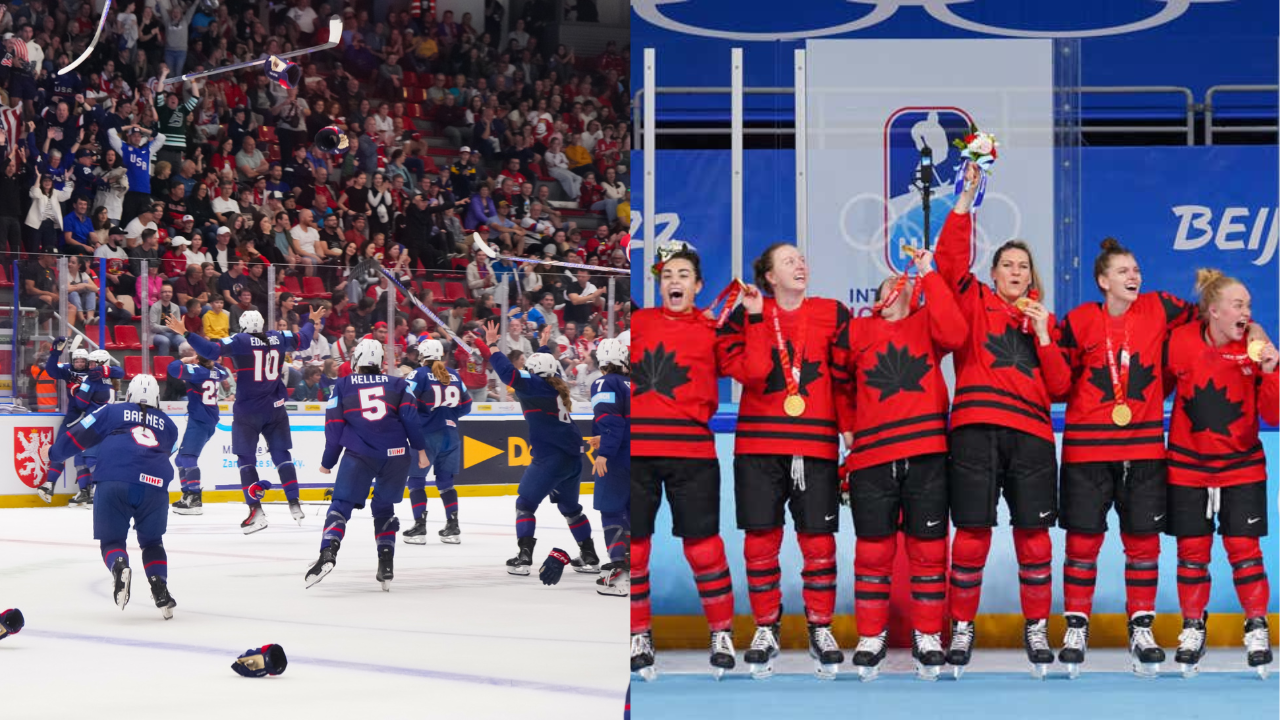
(Team USA Photo: USA Hockey/Twitter, Team CanadaPhoto: Hockey Canada)