
VANCOUVER, B.C. - The Goldeneyes are no longer in the race for the fourth and final PWHL playoff spot. Ottawa’s 5-1 win over New York on Saturday afternoon lifted the Charge to 39 points. The Goldeneyes needed to win all three of their final games in regulation to stay in the playoff race just to reach 39 points.
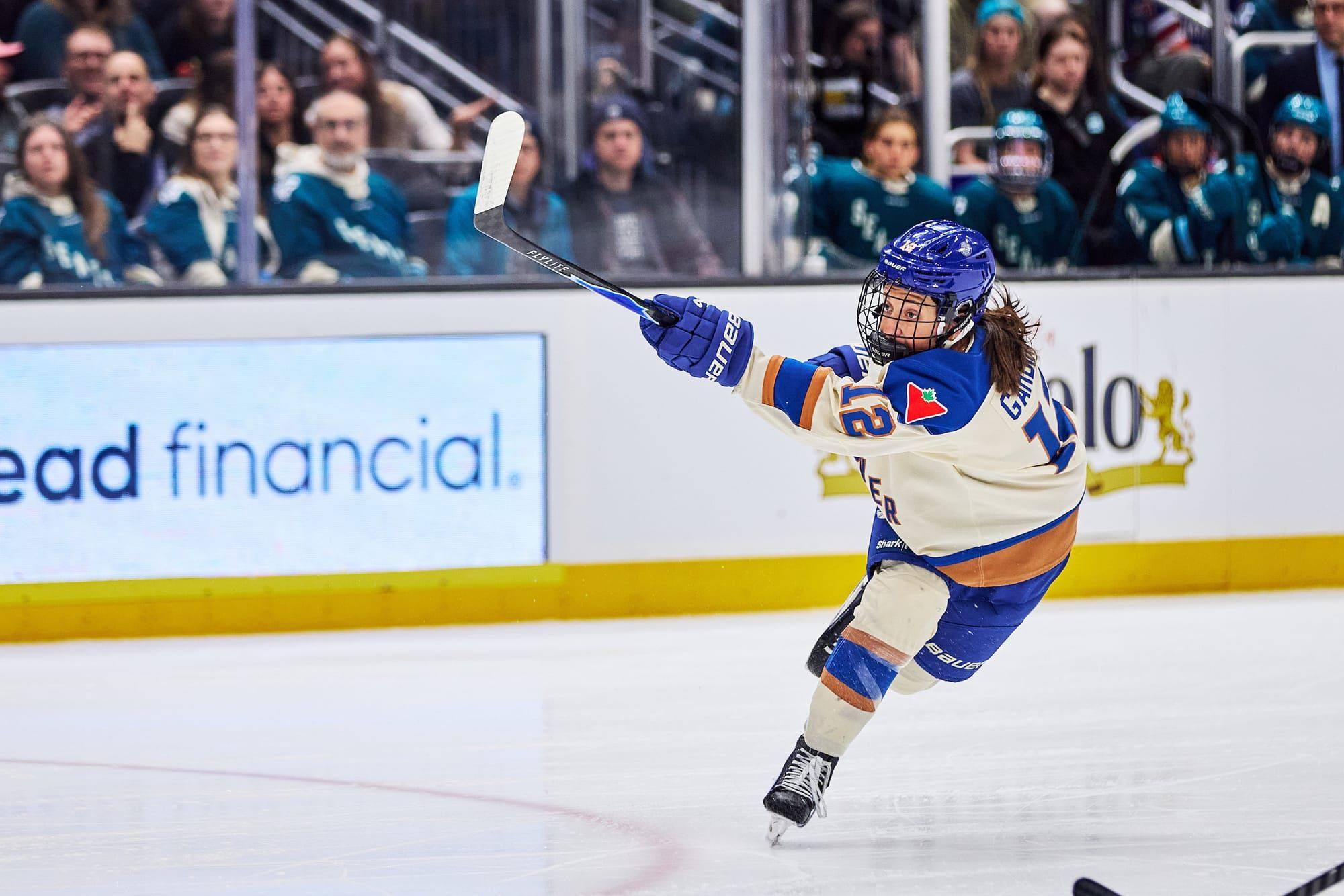
Jenn Gardiner became the first PWHL player to score four goals in a game on Saturday, but the Torrent’s three-goal third period forced overtime and was the final playoff dagger for the Goldeneyes.
Vancouver came back from a pair of two goal deficits to beat Seattle 6-5 in the extra frame, but the two standings points were not enough to keep them in contention.
A milestone game for our very own Jenny G 🤩 pic.twitter.com/9lLQ0ujtQT
— Vancouver Goldeneyes (@PWHL__Vancouver) April 19, 2026
Vancouver will now turn their attention to picking up points in the PWHL’s unique gold plan to try and earn the 1st overall selection in the 2026 PWHL Entry Draft. Seattle’s overtime loss gives them a one point advantage. Both Vancouver and Seattle have two remaining games where they can secure gold plan points.
The road has not been kind to the Goldeneyes. Vancouver has a 3-1-1-10 record outside of Vancouver. Their first two road wins were at Takeover Tour stops - a 4-3 win over Boston in Detroit on January 3 and a 3-1 win over Seattle in Denver on January 25. Vancouver’s lone regulation road victory in a PWHL arena came on March 29 when they beat Toronto 3-2.
Saturday’s game at Climate Pledge Arena was the first time Vancouver has scored six goals in a game. The Goldeneyes have scored 27 goals and allowed 47 goals away from home.
In trying to understand why they’ve struggled so much away from Vancouver, questions have arisen about how much of a factor travel is. Presumably the time spent on planes and crossing multiple time zones is impacting the players’ body clocks, practice time, and mental health.
In year one it is difficult to determine what disadvantage, if any, Vancouver and Seattle are at due to geography.
“We really don’t know the impact until we know the impact,” Goldeneyes GM Cara Gardner Morey told reporters in Vancouver this week.’
“They (PWHL) need to probably look into it using some of our scientific data as we go through. I don’t think that’s the biggest factor of what’s happening. There are a million factors. It’s an expansion team. I really don’t know how to solve for it. It’s worth it when we get to represent Vancouver.”
The recent five game, two week road trip that Vancouver completed on April 7 in Edmonton had Vancouver playing in Boston, Toronto, Montreal, and Minnesota. After the game in Alberta, head coach Brian Idalski was more pointed, voicing concerns about all the travel both expansion teams have had.
Goldeneyes head coach Brian Idalski: "It would be one thing if one of the expansion teams was killing it. We're both struggling. ... There's something that with the travel and us going back and forth that's happening to our bodies, and we need to learn how to manage that better." pic.twitter.com/y9wBREt5jT
— Kyle Cushman (@Kyle_Cush) April 8, 2026
“Allegedly I created a little stir there,” Idalski told reporters back in Vancouver this week, referring to the response to his comments in Edmonton.
There is no question that the Goldeneyes have had a challenging schedule this season, but it’s also true that those challenges are not unique to the PWHL. No matter the sport, over the course of a season flying all over North America on commercial flights takes a toll on any professional athlete.
What would Idalski do differently?
“Here’s what I would say about that,” Idalski said. “Maybe it was the jist of some of my comments. We don’t have data for some of the things that are happening. That was clearly my point. My point wasn’t blaming anybody. Our job is to win and some of that stuff is what it is, but I would love to see us be able to understand the flights, what that does to our body, tracking things, having more conversations about sleep and recovery. I don’t think we have a whole lot on that.”
The most recent road trip had the Goldeneyes away from Vancouver for more than two weeks as the group chose not to return home between games. There was a five day break between their first two games, in Boston and Toronto, but no more than three days between any of the other games.
During earlier stretches of the season when the Goldeneyes had multiple road games, the team elected to return home to Vancouver in between road games to practice and stay on pacific time before travelling out of market to complete their road trip.
Goldeneyes captain Ashton Bell has a clear preference of which length of trip she prefers.
“This last stretch we stayed out [east], which I enjoyed a little more. It helps with sleep. You get to get on the eastern time zone. I think our staff did a great job managing our schedule, flight times, allowing us to sleep in after a gameday and pushing back the travel a bit, having a day off here and there. Communication is key, how our bodies are feeling, what we need from them and what they need from us, coming up with the best plan going forward,” said Bell.
While the long road swings can be difficult in numerous ways, there are positives that come from spending so much time with each other. All that down time on planes, buses and in hotels can be great for individual and team bonding.
“The last [road trip] got a bit long. It can definitely take a toll on you physically and mentally. I personally love going on the road. I think our group loved being on the road just getting more time together away from the rink. When we’re [in Vancouver] everyone kind of goes back to their home and you really don’t get to see each other much, but on the road we’re together 24/7. I think that’s pretty special. You can learn a lot about one another when you’re on a bus for a while or a plane for a while. There’s lots of card games going on. It’s fun for us to build that chemistry off the ice,” said Bell.
Vancouver will wrap up the home portion of their schedule vs Montreal on Tuesday, April 21 and Minnesota on Saturday, April 25.
(Photo: PWHL)