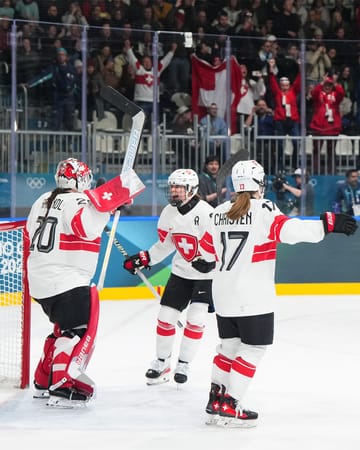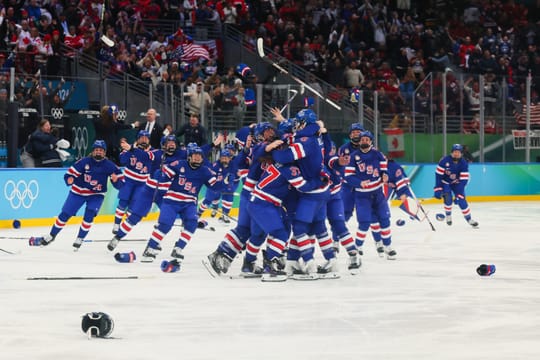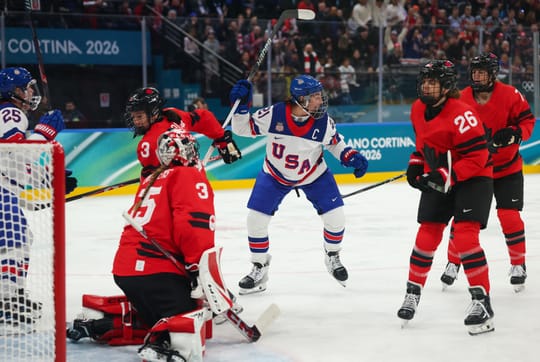

The women’s hockey tournament wrapped up its preliminary round with the postponed meeting between Canada and Finland. Next up, the quarterfinals.
12 February 2026
Finland vs. Canada: 5-0 Canada
The first 10 minutes of this match were really not looking good for Canada. It seemed like more of the same issues we’d seen against the U.S. and Switzerland, and then suddenly, the game turned.
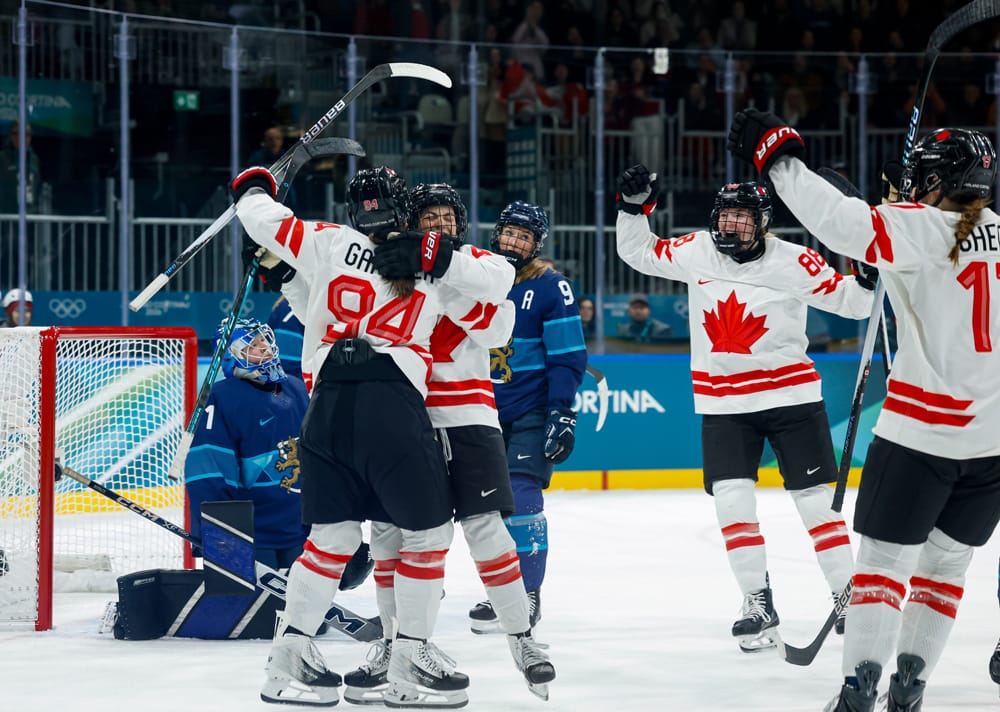
With about five minutes to go in the opening period, Kristin O’Neill won a board battle and tossed the puck toward the circle, where Julia Gosling managed to pick it up before any Finn could clear it and got the puck to Jenn Gardiner in the inner slot to open the scoring. The fact that the Canadians were in position to make that happen was an important improvement from previous games, though it’s worth noting that this wasn’t the only goal of the day where Canada was lucky that an off-target pass wasn’t cleared by the Finns before a Canadian could get to it.
Finland was very much in the game throughout, but Canada played more composed after taking the lead. The Finns also were much improved on the face-off dot, winning 27 of 48 after having gone sub-40% in their previous three games. While Finland had some excellent chances in the second period, Canada overall looked much calmer in its attack than it has so far and managed to consistently get inside and into dangerous positions in the offensive zone.
The Canadian defence was also much more engaged in driving the rush. This is an aspect of their game that has been at the very core of their success since 2021 but which was notably absent throughout this season, including the Olympic tournament so far. Canada has the personnel, with Claire Thompson, Sophie Jaques, Ella Shelton, and Renata Fast having all had plenty of success playing a style that has them heavily involved in the offence. It's a matter of implementation (and, perhaps, optimizing the pairings).
Over the course of the tournament, a lot of commentary regarding Canada’s less-than-stellar performances has been focused on the coaching systems (notably, without identifying what those systems are). But ultimately, the product on the ice hasn’t seemed to reflect what the coaching staff has asked of its roster. Troy Ryan’s postgame comments after this match provided an interesting glimpse behind the scenes, and described a change in approach from the coaching staff in order to try to reach players with actionable messaging.
The moment I heard him begin an answer with "We actually had a really… probably a weird pre-game meeting,” I was intrigued.
Readers from the professional world will likely be familiar with the notion of key performance indicators (KPIs), which are quantifiable targets used to evaluate whether strategic and operational goals are being successfully met. That might mean having an article reach a specified number of readers, or reducing processing timelines by a set number of days. For Team Canada right now, identifying KPIs is an attempt at making sure each line understands its role within the game and what it tangibly looks like to play that role well.
In that “weird” pre-game meeting, Ryan explained, the coaching staff provided players with performance indicators for the match. For example, he offered, "We need Filly's [Sarah Fillier’s] line to get six inner slot shots in this game; we need [Blayre] Turnbull's line to be F1 pressure and winning six or seven battles with them.
“We just tried to define their identity as a line, but something that was measurable from a statistical point of view,” Ryan continued. “It's just meant to give them a narrowed focus as opposed to looking at the bigger picture here. The win's the win, but if you take care of some of those little details, you start to play more to your identity.”
Essentially, Canada’s staff broke down exactly what it believed, based on the available data, each line needed to contribute in order for the team to successfully execute its game plan.
Fillier’s line played well against Finland, and Fillier herself in particular drove a lot of Canada’s offence, but the shot charts indicate that the example Ryan gave regarding shots from the inner slot wasn’t achieved. That, too, is something the staff has prepared for.
“What it does after this game, it's an easy conversation with me to sit down with the lines and say ‘Hey, this was our target, and you reached it or didn't reach it, and if you didn't reach it, let's see why you didn't reach it’,” he added. “So it just controls even the next-day narrative a little bit. It's kind of random to do it at this point, but sometimes you've got to distract them from some of the bigger things going on and you've got to kind of narrow what you want them to try to accomplish."
For a group that has by and large been rushing weak shots from the outside, being given clear objectives that necessarily involved getting into dangerous positions and improving the condition of the puck does seem to have made a difference. Personally, I am instantly interested in any approach that a coach self-admittedly describes as “random”. But above all, I think this reinforces that the problems we’ve seen with Canada’s play have had more to do with execution than with the underlying plan of attack.
To be at their best, the Canadians are going to need to return to a style of play that they haven’t managed to implement since last year. The postponed game was a blessing in disguise in that sense, as it gave Canada the opportunity to work things out against an opponent that is dangerous enough to capitalize on errors, but enough of a step down from the U.S. to provide breathing room to try new things. Whether they can effectively revamp their play in the span of a week is the biggest question surrounding this team – perhaps even bigger than the status of Marie-Philip Poulin, who the coaches seem confident will return before the end of the Games.
On that note, there were a couple scary moments for both sides in this match. When Fillier went down the tunnel clutching her arm in the second period, Canada’s entire tournament was beginning to feel like a sick joke. Fortunately, she returned to the bench fairly quickly and didn’t seem to struggle in the rest of the game. For the Finns, defender Jenni Hiirikoski left the game early in visible pain and did not return.
Looking ahead
A few things to keep an eye on in the quarterfinals:
Czechia vs. Sweden
Can Sweden keep up its offensive flow against a much tougher Czech team, and can its defence handle the test? Can Czechia slow down the Swedes without getting into penalty trouble?
USA vs. Italy
How well can Italy maintain its structure against a relentless U.S. team? Can Team USA get its power play units to their full potential?
Canada vs. Germany
How will the Canadians implement their areas of focus, and can they do it without getting complacent against a slower opponent? How well can the German defence prevent them from getting into dangerous spaces?
Finland vs. Switzerland
Can a more-rested Swiss team do a better job of keeping Finland to the outside in this rematch? Can the Finns score, or was the previous meeting – the only preliminary game in which they managed any goals – a fluke?
(Photo: Hockey Canada/X)